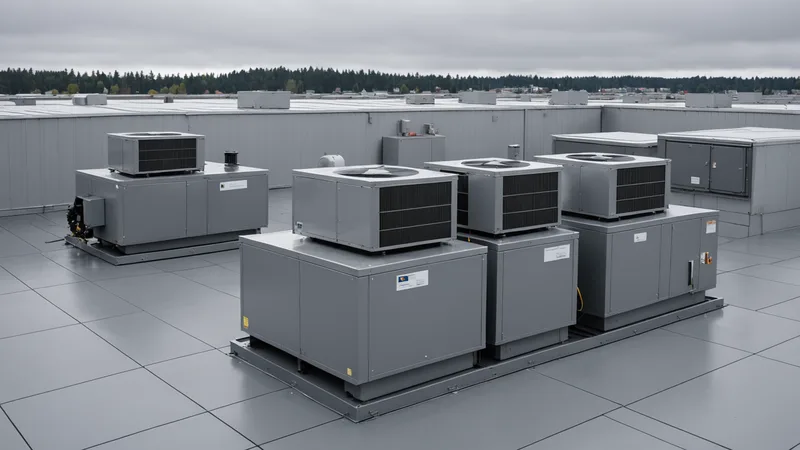
The BMS schedule in a 90,000 sq ft office building in Portland's Pearl District starts the air handlers at 6:00 AM every day — Monday through Sunday, January through December. It was set that way in 2009 when the building was commissioned. It has been adjusted once since: a facilities manager added a two-hour manual override for an after-hours event and then forgot to remove it from the Saturday morning block.
Nobody is doing anything wrong here. The building is being operated exactly as the BMS was designed to be operated. The problem is that the design itself is 30 years out of date.
The Fixed-Schedule Model and Why It Persisted
Commercial building automation systems were built around a core assumption: occupancy is predictable, and predictable occupancy means a fixed weekly schedule is sufficient. Set the HVAC to run from 6 AM to 9 PM Monday through Friday, reduce setpoints over the weekend, and the building will be comfortable when occupied and not wasteful when empty.
That assumption was reasonable in 1995. It became less reasonable as energy tariff structures evolved. And it is actively costly in 2025, when commercial buildings in Oregon face time-of-use demand charges that can represent 30–40% of a monthly electric bill — charges tied not to total consumption but to peak demand within specific 15-minute intervals.
The fixed-schedule model doesn't distinguish between 9 AM on a Tuesday and 9 AM on a day when outdoor temperatures are 97°F and the utility's peak demand window opens at 2 PM. The BMS starts the air handlers at 6 AM in both cases. In the first scenario, that's fine. In the second scenario, the building is chasing peak comfort temperatures exactly when the tariff is most expensive, and the peak demand charge for the month is set during the very window the BMS could have pre-empted.
The Commissioning Gap: Why Schedules Never Get Updated
Commissioning engineers set HVAC schedules conservatively — they build in margin for the worst-case scenario (maximum occupancy, extreme outdoor temperatures, equipment running slightly below spec). That conservatism costs money every day the building is running below worst-case conditions, which is most days.
After commissioning, schedule updates require someone to decide to make them. That decision requires a hypothesis (the schedule is wrong for current conditions), data (when is the building actually occupied?), and confidence in the outcome (will changing the schedule cause comfort complaints?). Most facilities teams don't have comfortable access to all three simultaneously.
The result is the commissioning schedule running indefinitely. We have talked to facilities managers running buildings where the BMS schedule hasn't been formally reviewed since the Obama administration. Not because anyone is negligent — because updating a BMS schedule is a non-trivial task that requires coordination between the controls contractor, the facilities manager, and often the tenant, and the risk of getting it wrong (comfort complaints, equipment alarms) feels larger than the cost of leaving it alone.
Three Things the Fixed-Schedule Model Cannot See
Here is the structural problem with fixed schedules, broken into its three components:
Weather. A BMS schedule starts the air handlers at the same time regardless of outdoor temperature. A building that needs 3 hours to pre-cool to comfort temperature on a 95°F day needs only 45 minutes on a 68°F day. The schedule can't know which scenario it's in. The result is systematic over-conditioning on mild days (waste) and systematic under-conditioning lead time on hot days (comfort issues and missed pre-cooling opportunities before peak tariff windows).
Actual occupancy. The schedule assumes the building is occupied when it's supposed to be and empty when it's supposed to be. Reality: a mid-size commercial office building might see 20% occupancy on a random Friday afternoon, 95% on a Tuesday morning, and zero on a building holiday the facilities manager forgot to add to the BMS calendar in 2023. The fixed schedule runs the same conditioning regime regardless of whether there are 12 people or 400 people in the building.
The tariff window. The most expensive 15-minute interval on your utility bill might happen at 3:47 PM on a Wednesday in August. The BMS has no idea. It runs full cooling at 2 PM because the schedule says to. It could have run the same cooling at 11 AM, reached the same comfortable temperature by 3 PM, and coasted through the peak window on thermal mass — but only if it knew when the peak window was and how long the building's thermal mass would hold.
What This Actually Costs: A Concrete Example
Take a 75,000 sq ft Class B office building in the Portland metro area, paying PGE commercial rates with a demand charge in the range of $12–16/kW. The building's HVAC system draws roughly 180 kW at full operation. On peak demand days, the building runs full conditioning from 1 PM onward, setting a demand charge contribution of approximately 180 kW across the 4–8 PM peak window.
If the building could pre-condition from 10 AM to 1 PM — reaching target temperatures before the peak window opens — the HVAC would coast at reduced load (maybe 60–80 kW) during the highest-cost period. At $14/kW demand charge and 100 kW of avoided peak demand, that's $1,400 avoided on a single peak day. Buildings in Portland's climate might see 15–25 peak demand days per year where this intervention is meaningful.
We're not saying a fixed schedule is negligent — we're saying it was designed for a tariff environment that no longer exists, and the gap between what it does and what's now optimal has grown substantially.
Why BMS Vendors Haven't Solved This
Major BMS platforms — Honeywell Forge, Siemens Desigo CC, JCI Metasys, Niagara N4 — have added "optimization" features in recent versions. Most of them center on fault detection and diagnostics (FDD): finding equipment that is performing below specification, identifying sensor drift, flagging scheduling conflicts. FDD is valuable, but it does not solve the scheduling problem.
The scheduling problem requires three things that BMS platforms structurally cannot provide from within the building: real-time utility tariff schedule data, current weather and 48-hour forecast data, and a per-building thermal inertia model that tells the system how far in advance to begin pre-conditioning given current conditions. BMS platforms are designed to control the building, not to gather and process external data feeds and run predictive calculations on top of them.
This is a layering problem, not a BMS failure. The BMS does what it was designed to do. What it needs is a control layer above it that can see the external data (tariff windows, weather forecast) and translate that into setpoint commands the BMS can execute. That layer is what has been missing.
What a Correct Schedule Actually Looks Like
A correct HVAC schedule for a commercial building isn't a fixed time table — it's a dynamic plan that answers: given today's weather forecast, tomorrow's tariff schedule, and the building's known thermal response characteristics, what setpoint command should be issued now, and in what zone, to reach comfort conditions before occupancy while minimizing peak demand charge contribution?
That question cannot be answered at commissioning time. It can only be answered each day, using current data. The answer will be different on a cloudy 60°F Tuesday in November and a sunny 94°F Wednesday in August. The answer will also differ between a southwest-facing conference room with direct solar gain and a north-facing office suite that holds temperature longer.
Building automation hasn't been stuck because the problem was hard. It's been stuck because the economic incentive to solve it at the individual building level wasn't strong enough to justify the engineering work — until tariff structures made demand charge avoidance worth $15,000–40,000 per year for a mid-size office building. At that scale, a predictive control layer pays for itself in the first couple of months.
The schedule your BMS is running right now was written for a different building, on a different day, in a different energy market. That's the problem worth solving.